Forestill deg at du faller
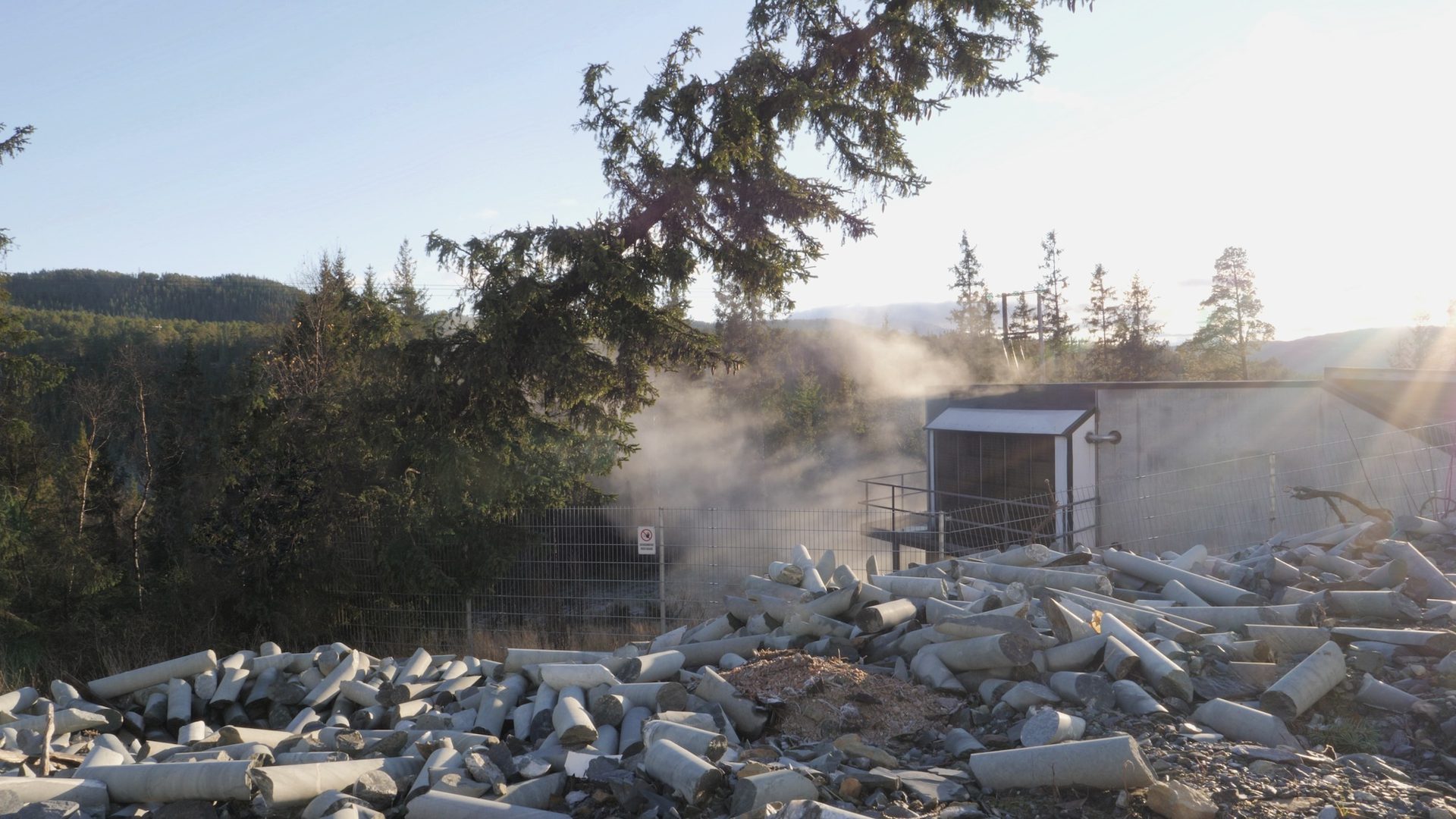
Helene Sommer, Undergrunnsbevegelser, 2026
This year marks 190 years since Oslo Kunstforening was founded as Norway’s first exhibition space for art. There is a strong symbolism in opening the anniversary year with this exhibition – an exhibition that brings together artists from different generations who have impacted the Norwegian art scene not only as artists, but also as educators, curators, and key contributors across different fields of practice.
The artist group encompasses a wide range of practices and disciplines. It is precisely this diversity that reflects Oslo Kunstforening’s aim to be an open exhibition space where multiple perspectives can coexist side by side. Our work in recent years – with an emphasis on in-depth explorations of the institution’s own exhibition history, presentations of established artistic practices, the introduction of younger curators, and the presentation of tomorrow’s artists through the Academy of Fine Art’s graduation exhibition – are all expressions of this ambition.
When this group got in touch nearly two years ago, they already had an almost fully developed exhibition concept, conceived with Oslo Kunstforening’s exhibition spaces in mind. The practices of some of the group’s members I knew well from before, such as Per Christian Brown’s compelling and precisely composed photographic projects and Helene Sommer’s essayistic videos. Others represented more recent Norwegian art history that I wanted to become better acquainted with, such as Book & Hedén, who, through their conceptual and socially engaged art, helped shape important currents on the Norwegian art scene in the early 1990s. Hege Nyborg’s work as an artist and curator – among other things through her thorough examination of the history of Kunstnerforbundet – has made an important contribution to the understanding of our recent art history, while Thorbjørn Sørensen’s versatile practice has distinguished itself through a sustained investigation into what painting can be.
Over the past ten years, the artists in this group have established a platform for conversations, discussions, and exhibitions rooted in a shared interest in art, theory, nature, and literature. In Forestill deg at du faller [Imagine That You Are Falling], they take the history of things, their use, and their biographies as their departure point. The dense and complex relationships between things and their surroundings are manifested in individual works consisting of painting, photography, video, sculpture, and installation. The thing can be said to exist in a space between nature and culture and is a materialization of the past in the present.
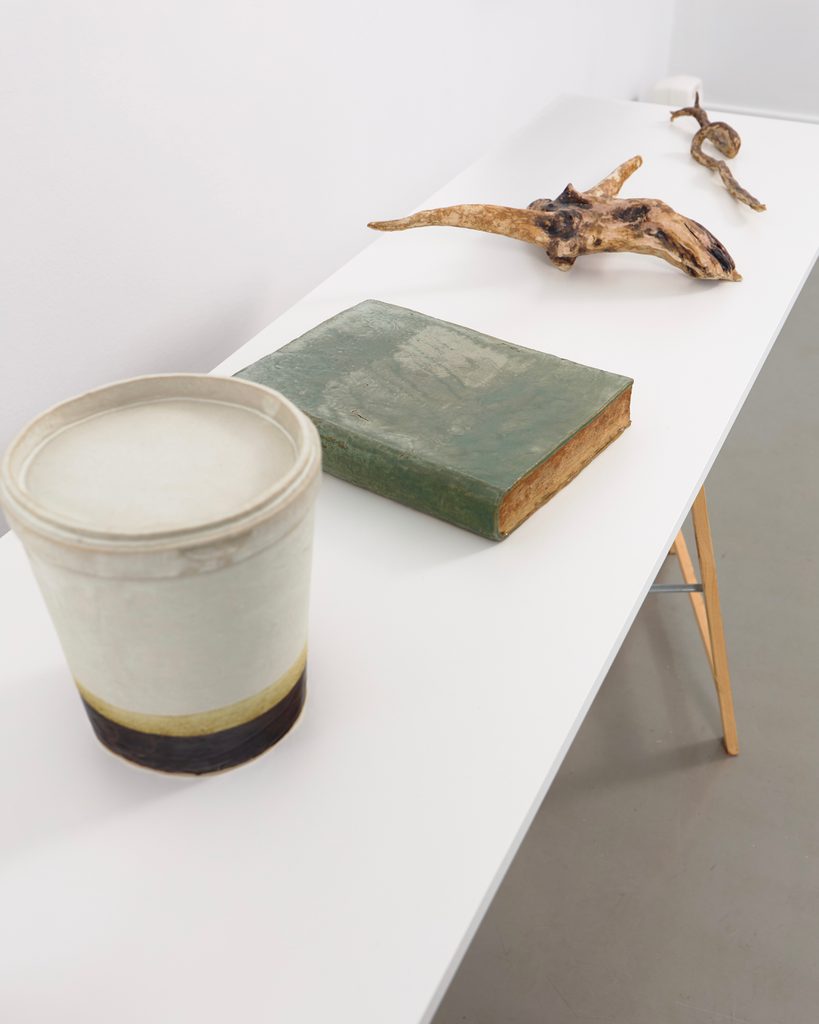
Book & Hedén, Arvegodset, 2026. Photo: Henrik Follesø Egeland
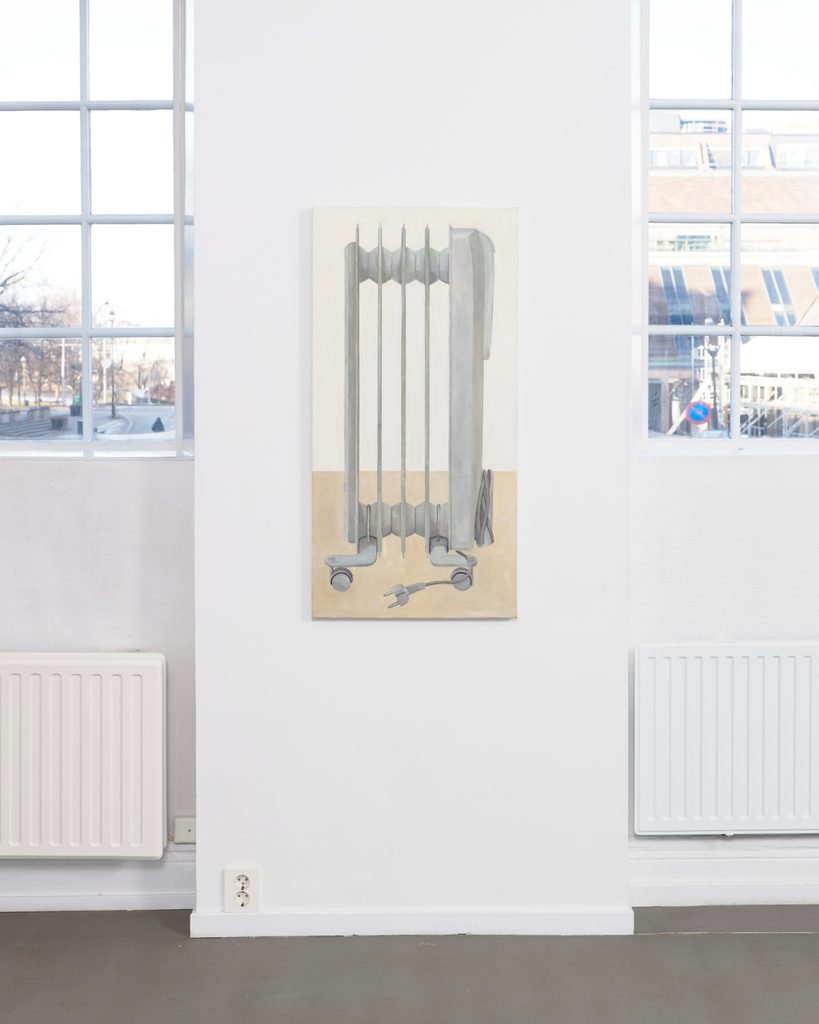
Thorbjørn Sørensen, Radiator, 2025. Photo: Henrik Follesø Egeland
The group states that: We are interested in how the thing exists in relation to – and on equal terms with – humans, plants, and animals. How do things communicate time, and is their apparent inanimacy merely a reflection of our limited perspective? In our respective works, we explore these themes from different angles – from the voices of things in the home and how they encapsulate memories, to the margins of things and things as historical objects, the order, physiology, and systematization of things, and to the sorting and archiving of the things we leave behind.
The title of the exhibition refers to artist Hito Steyerl’s text In Free Fall: A Thought Experiment on Vertical Perspective (e-flux Journal, 2011), in which she analyses the shift from classical linear perspective to the vertical perspective of the drone and the satellite. Steyerl describes how this movement entails a free fall toward something unknown, with no solid ground beneath us and no sky above us; “Falling is both ruin and release, a state in which people turn into things – and things turn into people.”
The group asks whether the things around us might nevertheless be what keeps us grounded?
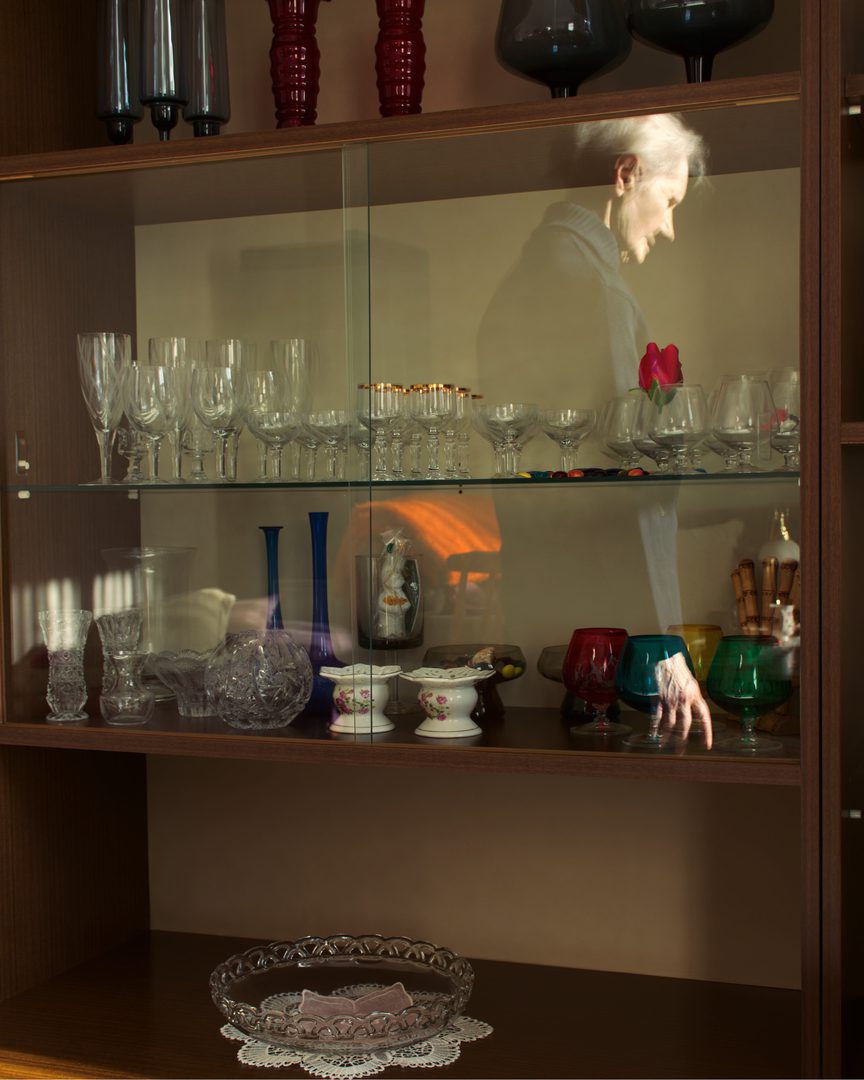
The exhibition brings together artistic investigations of time, memory, and materiality, in which the personal, the historical, and the geological are interwoven. In Per Christian Brown’s Det som var, det som er, og det som kommer: fortellinger fra en bygård i Berlin [What Was, What Is and What Will Come: Stories from an Apartment Building in Berlin], an apartment building and its inhabitants become a living archive, recorded with video and photography. In Book & Hedén’s installation Lageret, Arvegodset, Muren [The Storage, the Heirlooms, the Wall], the vast quantities of artistic production that must be discarded are set against objects’ potential to generate new meanings. Hege Nyborg’s 13 stasjoner for det anakrone objektet [13 Stations for the Anachronic Object] moves between the present and the Jurassic period, examining how knowledge, speculation, and matter can be connected across science and fiction. In Helene Sommer’s video Undergrunnsbevegelser [Underground Movements], the Earth’s interior is presented as an archive of time and movement, where the drill core becomes an image of the relationship between humanity, science, and nature. In Thorbjørn Sørensen’s paintings, things around us – everyday, recognizable objects – appear as charged and meaningful in their simplicity.
Taken together, the works in the exhibition point to how the various archives of things shape us – whether they exist in apartment buildings, in storage spaces, in our memory, in historical objects, or in kilometre-deep layers of earth – and how they inscribe and influence our existence in different ways.
Elisabeth Byre
Artistic Director, Oslo Kunstforening
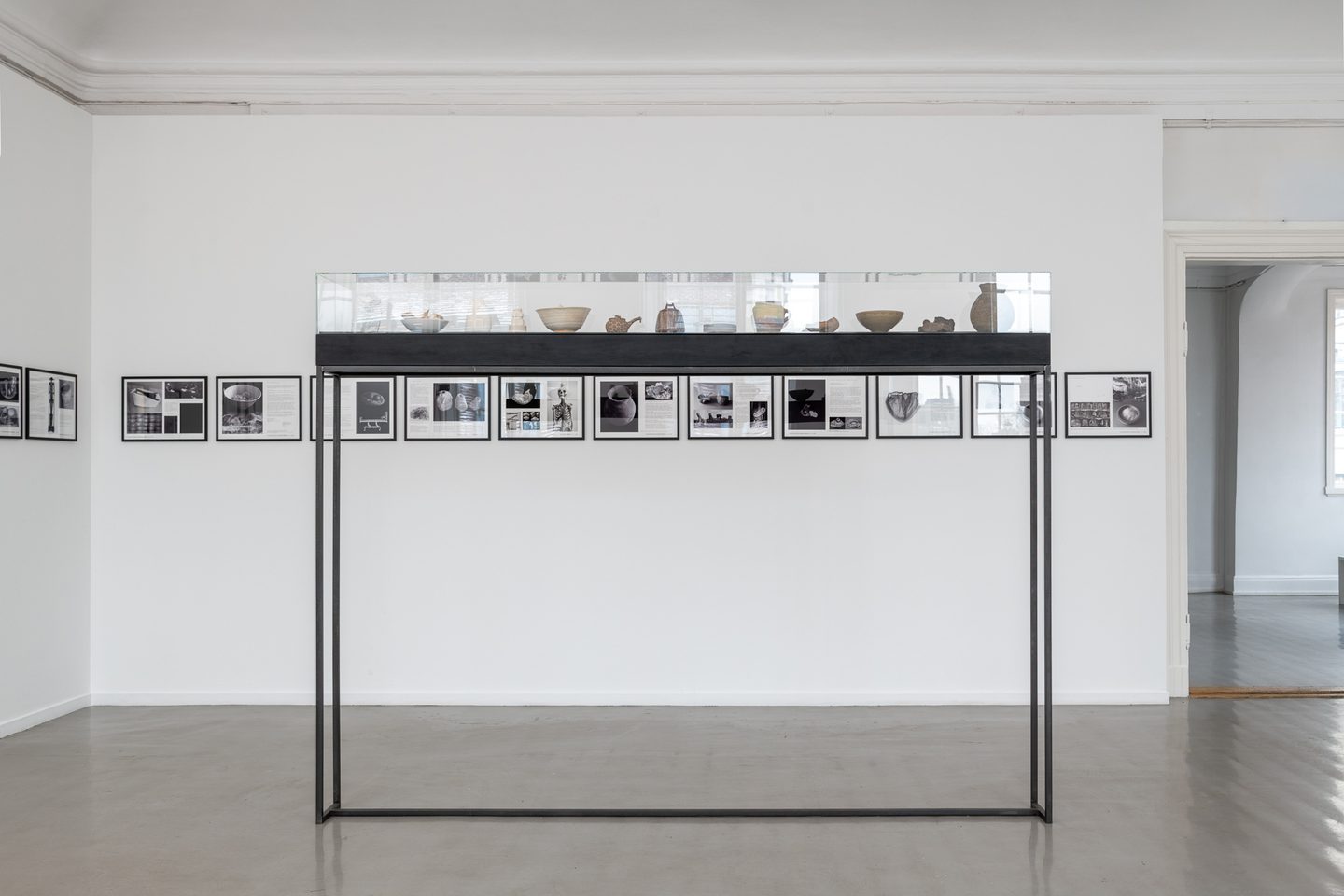
Hege Nyborg, 13 stasjoner for det anakrone objektet, 2026. Photo: Thomas Tveter
Hege Nyborg
Hege Nyborg’s work 13 stasjoner for det anakrone objektet [13 stations for the anachronic object] consists of text, photography, utilitarian objects, organic material, and minerals, spanning a historical arc between the present and the Earth’s Jurassic period. Through references to science, literature, and science fiction, Nyborg examines how speculative knowledge and established models of understanding can be recombined in new ways. The juxtapositions draw on: the experiments of the scientist and inventor Martial Canterel in Raymond Roussel’s novel Locus Solus (1914); Ursula Le Guin’s science-fiction anthropologies; speculative research; as well as obsolete scientific treatises on minerals, ether, electricity, and breath. The project sets different – and at times old and contradictory – ways of understanding the world against one another, demonstrating that they all have a right to exist side by side.
Hege Nyborg (b. 1960) was educated at the National College of Art and Design and the National Academy of Fine Arts in Oslo, Amherst College in the United States, and the Academy of Fine Arts Vienna in Austria. Nyborg has exhibited at institutions including Kunstnernes Hus (2023), Kunstnerforbundet (2021), Sørlandets Kunstmuseum (2013), and the National Museum of Art, Architecture and Design (2010). Her work is included in collections such as the National Museum, Sørlandets Kunstmuseum, Trondheim Kunstmuseum, and Arts Council Norway.
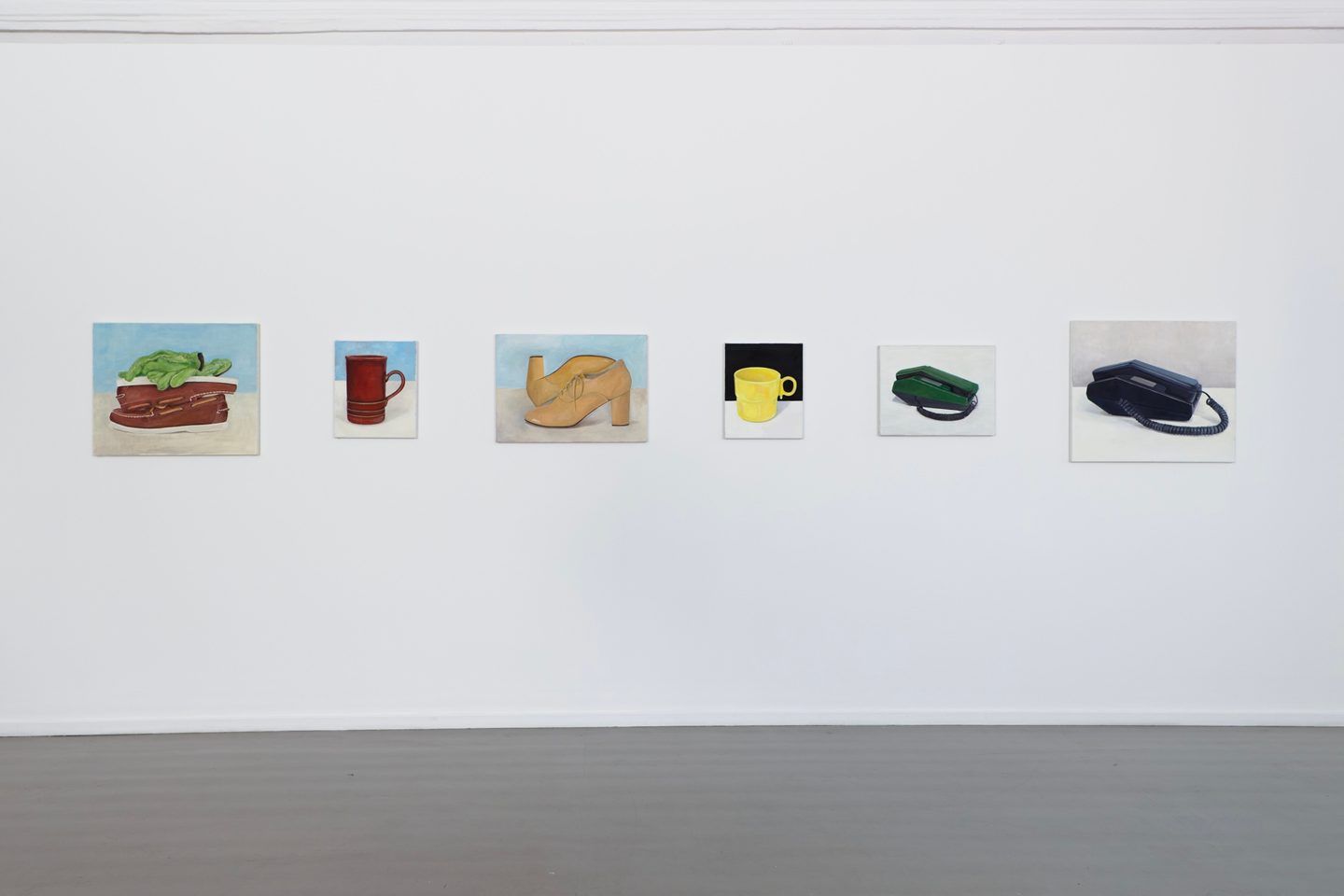
Thorbjørn Sørensen, Grønne hansker på brune sko, Kaffekopp, Sko, Gul kopp, Tastafon I, Tastafon II, 2025 og 2026. Photo: Henrik Follesø Egeland
Thorbjørn Sørensen presents a series of new paintings dedicated to things – a cup, an outdated telephone, a pair of worn shoes. These are trivial yet necessary objects, objects with strong emotional or symbolic value, or objects that simply irritate and lodge themselves in the consciousness. He says: “I want to enter into those things that, in a curious way, provide keys to the realm of memory. It can be as simple as the yellow plastic cup I can never quite bring myself to throw away. It was filled with the best flavours, and the memories emerge crystal clear. Is it possible to evoke this memory in painting? Can painting entice and transform a yellow plastic cup into a sensuous, yellow, smooth painterly surface that does justice to this small yet significant thing?”
Since his years of study at the Academy of Fine Arts in the late 1980s, Sørensen has used objects from his own everyday life as part of his range of motifs. Through sober depictions of his surroundings – a bathroom with simple props, interiors with flower vases, naturalistic motifs of birds and plants, or an everyday breakfast table – the paintings revolve around what exists in the artist’s immediate vicinity.
Thorbjørn Sørensen (b. 1961) was educated at the National College of Art and Design and the National Academy of Fine Arts in Oslo. He has exhibited at institutions including Tegnerforbundet (2024), STANDARD (OSLO) (2021), and Bomuldsfabriken Kunsthall (2015), and has held numerous exhibitions at Galleri Wang, Galleri K, and OSL contemporary. Sørensen’s work is included in collections such as the National Museum, the Astrup Fearnley Museum, the Norwegian Ministry of Foreign Affairs, and the Arts Council Norway.
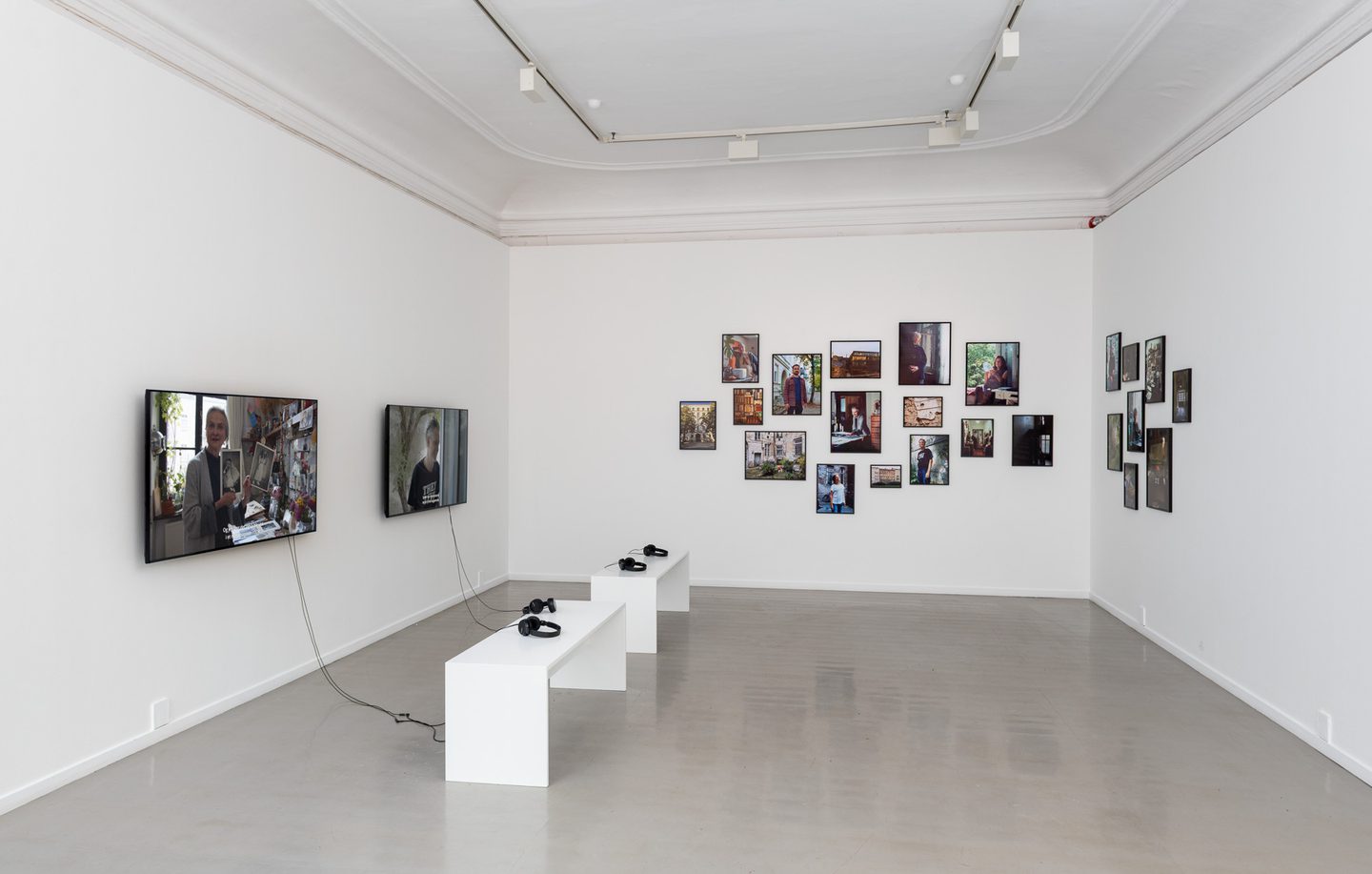
Per Christian Brown, Det som var, det som er, og det som kommer: fortellinger fra en bygård i Berlin, 2025. Photo: Thomas Tveter
Per Christian Brown
Per Christian Brown’s Det som var, det som er, og det som kommer: fortellinger fra en bygård i Berlin [What was, What is, and What Will Come: Stories From an Apartment Building in Berlin] is a video- and photo based documentary work about the residents of the apartment building in which he has lived for the past 20 years. Through portraits and interviews, the building is presented as a living archive, where the people and the objects surrounding them carry memories of both everyday life and major historical upheavals. Several of the neighbors lived through the GDR period, a time marked by surveillance and fear, but also by a strong sense of community. The building has witnessed Germany’s many eras, from the Empire and the unrest of the interwar years, to the devastation of the Second World War, the GDR republic, and the years following the fall of the Wall. Today, the building’s façade has been restored, but inside there are still clear traces of the past. A central theme in the project is the role of objects and the things we surround ourselves with as carriers of memory, belonging, and identity.
Per Christian Brown (b. 1976) was educated at the National Academy of Fine Arts in Oslo and the Bergen National Academy of the Arts. He has held solo exhibitions at institutions like Rogaland Art Centre (2025), Kunstnerforbundet (2017), Stavanger Museum (2014), and Galleri F15 (2013), in addition to numerous group exhibitions in Norway and abroad. Brown’s works are represented in collections such as Stavanger Kunstmuseum, Nordnorsk Kunstmuseum, and the City of Oslo Art Collection.
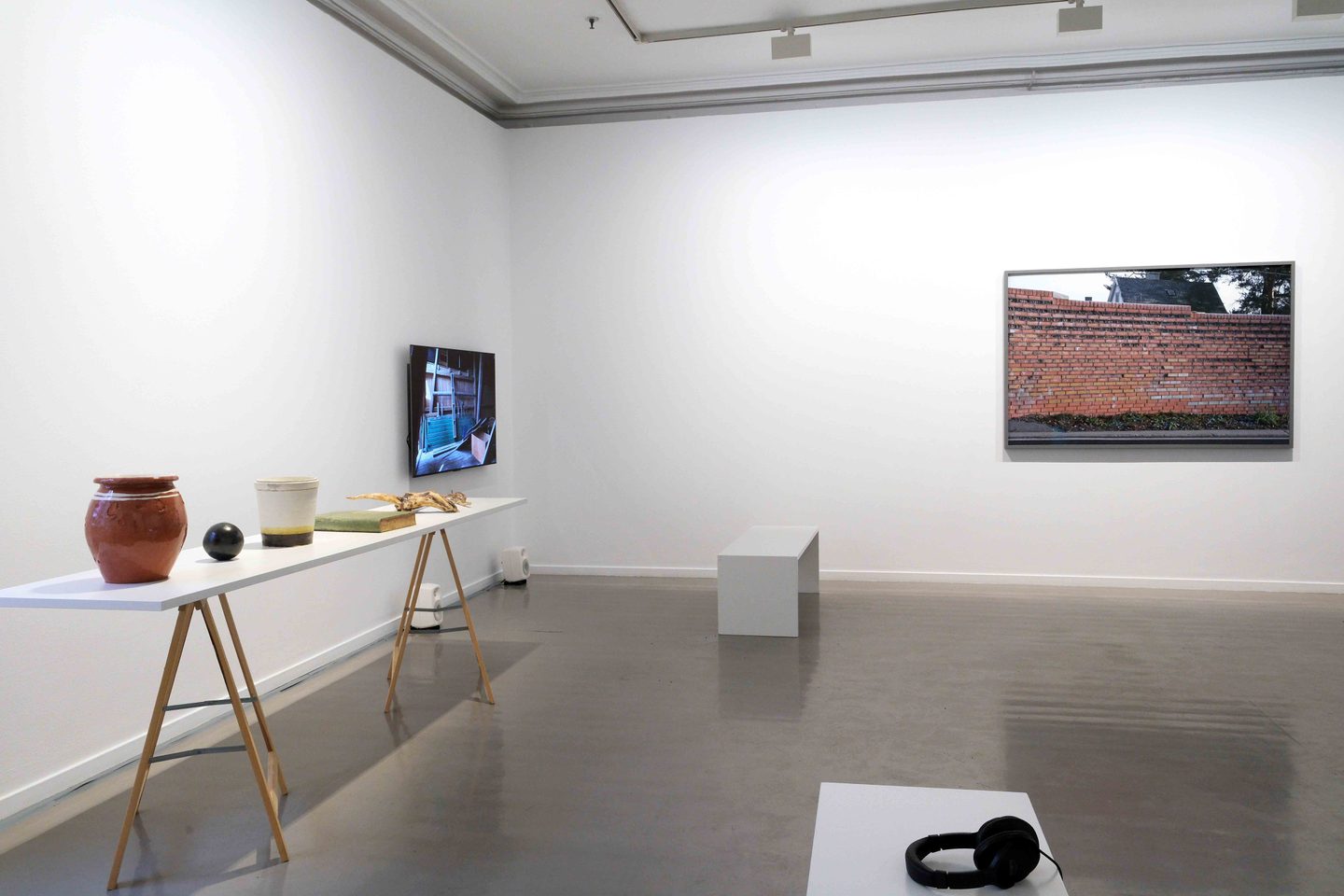
Book & Hedén, Lageret, Arvegodset, Muren, 2026. Photo: Thomas Tveter
Book & Hedén
In the work of the duo Book & Hedén, we are invited into an old storage space where artworks have been kept for many years, gathering dust and forgotten. The installation Lageret, Arvegodset, Muren [The Storage, the Heirlooms, the Wall] demonstrates in different ways in which art produced over a long career must eventually be discarded. The installation also shows how inherited objects – seemingly worthless and everyday things one has not chosen to own – are kept and serve as points of departure for new artworks.
The video Lageret [The Storage] is based on the clearing out and sorting of an almost 40-year-old storage space containing works kept in an old barn in Østfold. The artists state: “When one encounters time, made visible through the transformations of things, many questions and emotions arise, including a deep sense of shame over repression, forgetfulness, and what one has failed to take care of. So many things emerge from an artist’s life. And where do they go? Should they be stored? The dust, the color, the annihilation of the works. Collecting as an attempt to slow down time, to pretend that time is not an enemy? And where do these things ultimately end up – what does this idea of eternal life entail? As a consolation, the idea was to make video recordings and document the process. Large parts of what was in storage were discarded at the recycling station.” Arvegodset [The Heirlooms] consists of six different objects modelled and fired in clay, based on items the artists have inherited, enlarged to a scale of 1.5. Muren [The Wall] is a photograph of a brick wall along Ring 3 in Oslo, a wall that is gradually deteriorating.
Ingrid Book (b. 1951) was educated at the National College of Art and Design and the National Academy of Fine Arts in Oslo, and Carina Hedén (b. 1948) was educated at Lund University in Sweden and the Jan van Eyck Academie in the Netherlands. From 1990 to 1996, they taught at the National Academy of Fine Arts in Oslo. They have an extensive exhibition practice and have exhibited at institutions like Kunstbanken (2021), Kunstnerforbundet (2018), Henie Onstad Art Center (2016), Moderna Museet in Stockholm (2010), and Bergen Kunsthall (2008). They have participated in international biennials such as the Berlin Biennale (2004), the São Paulo Biennial (2004), and the Venice Biennale (2003). Book & Hedén’s works are included in several collections, including the National Museum, the Gothenburg Museum of Art, and the City of Oslo Art Collection.
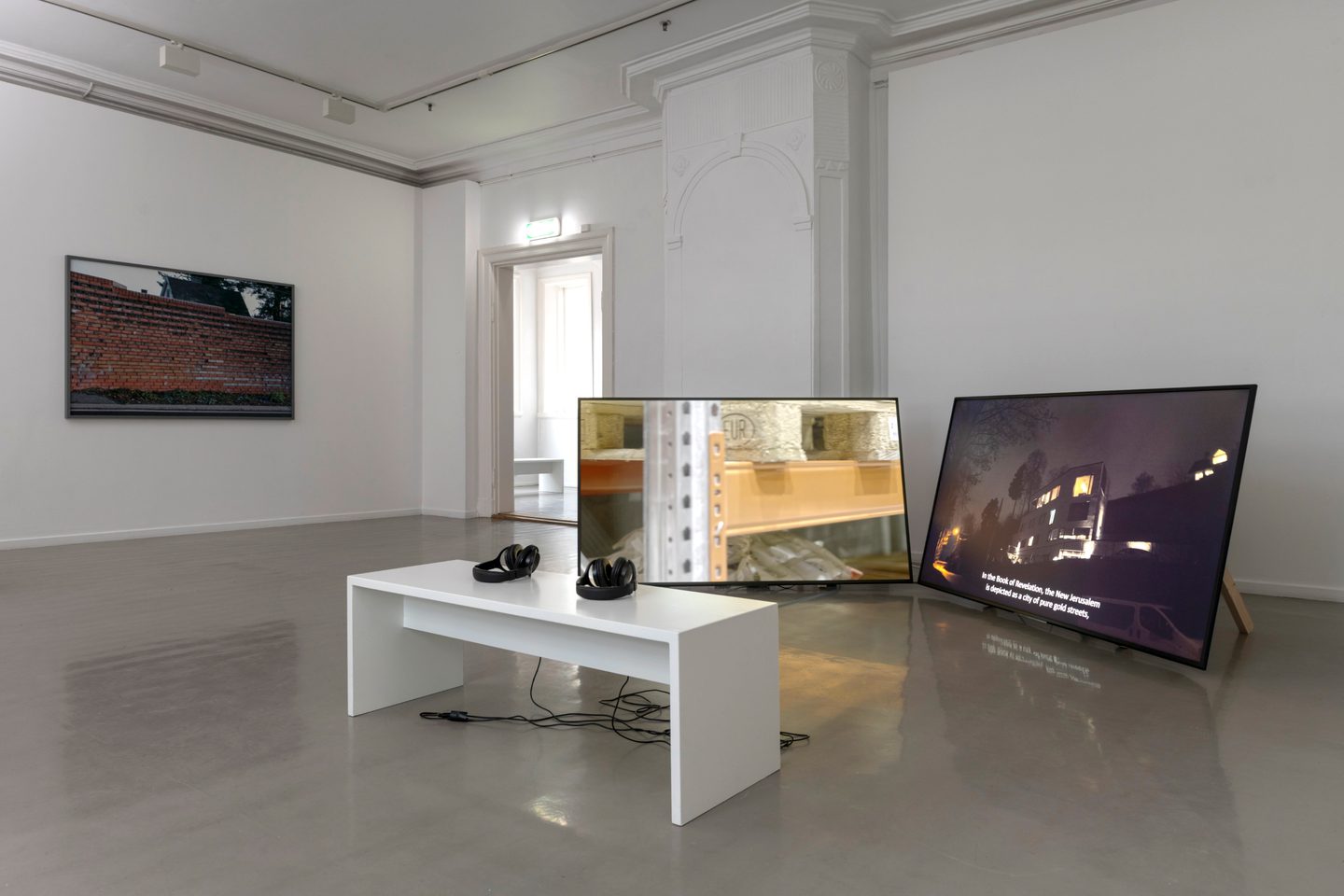
Helene Sommer, Undergrunnsbevegelser, 2026. Photo: Thomas Tveter
Helene Sommer
In Helene Sommer’s video essay Undergrunnsbevegelser [Underground Movements], the Earth’s interior is opened up as an archive of time, memory, and movement. Using core samples as a starting point – a vertical section through layers of rock, history, and millions of years – the work explores the relationship between humans, science, and the ground beneath our feet. When the mining industry began extracting cores in the late 19th century, they were largely not considered worthy of preservation beyond their immediate, practical function. In the 1990s, the Geological Survey of Norway decided to establish The National Drill Core and Sample Center, recognizing the value these cores represent. The archive was established in a former mining area in Trøndelag and functions as a national repository of Norway’s geological heritage. Today, nearly 800,000 meters of core samples from across the country are stored there. The extraction and systematization of these cores carry the paradox of their almost utopian and fantastical role as storytellers and sources of information, while simultaneously highlighting the problematic aspects of our relationship with natural resources. In the work, the core samples are situated in relation to science, science fiction, language, and mythology. Recordings were made, among other locations, at the The National Drill Core and Sample Center in Løkken, Trøndelag; the core storage facility of Store Norske Spitsbergen Kulkompani in Svalbard; the Geological Museum; and the University of Oslo.
Helene Sommer (b. 1978) was educated at the National Academy of Fine Arts in Oslo. She has exhibited at institutions like BO – Billedkunstnerne i Oslo (2023), Kristiansand Kunsthall (2020), Fotogalleriet (2020), Nordnorsk Kunstnersenter (2019), and Atelier Nord (2018). Her films have been screened at numerous film festivals both in Norway and abroad. Sommer’s work is included in collections such as the National Museum, the Jugendstilsenteret, and KUBE.
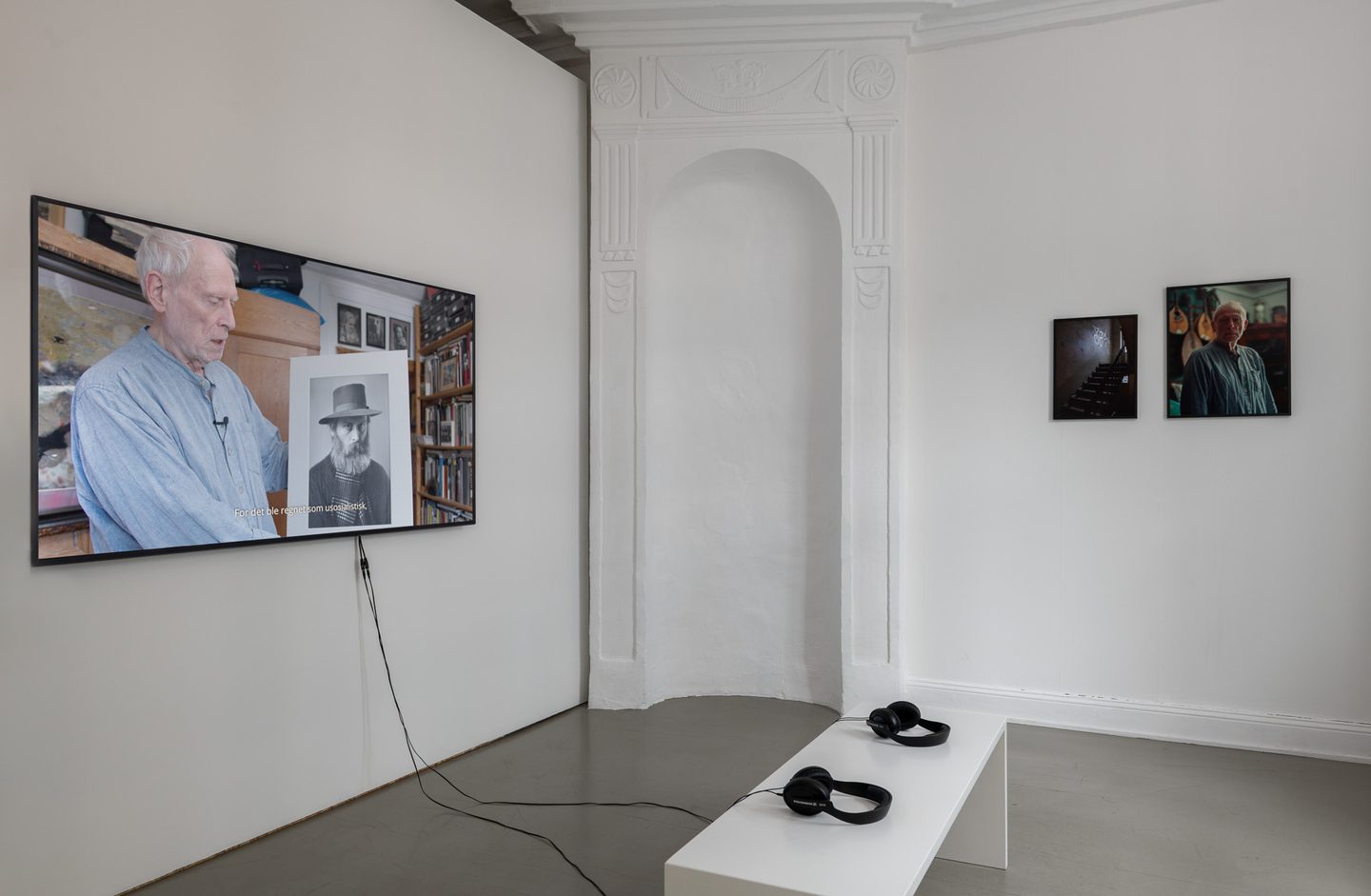
Per Christian Brown, Det som var, det som er, og det som kommer: fortellinger fra en bygård i Berlin, 2025. Photo: Thomas Tveter
On Wednesday, 25 February from 18:00, there will be an artist talk at Oslo Kunstforening with all the exhibiting artists, led by Elisabeth Byre.
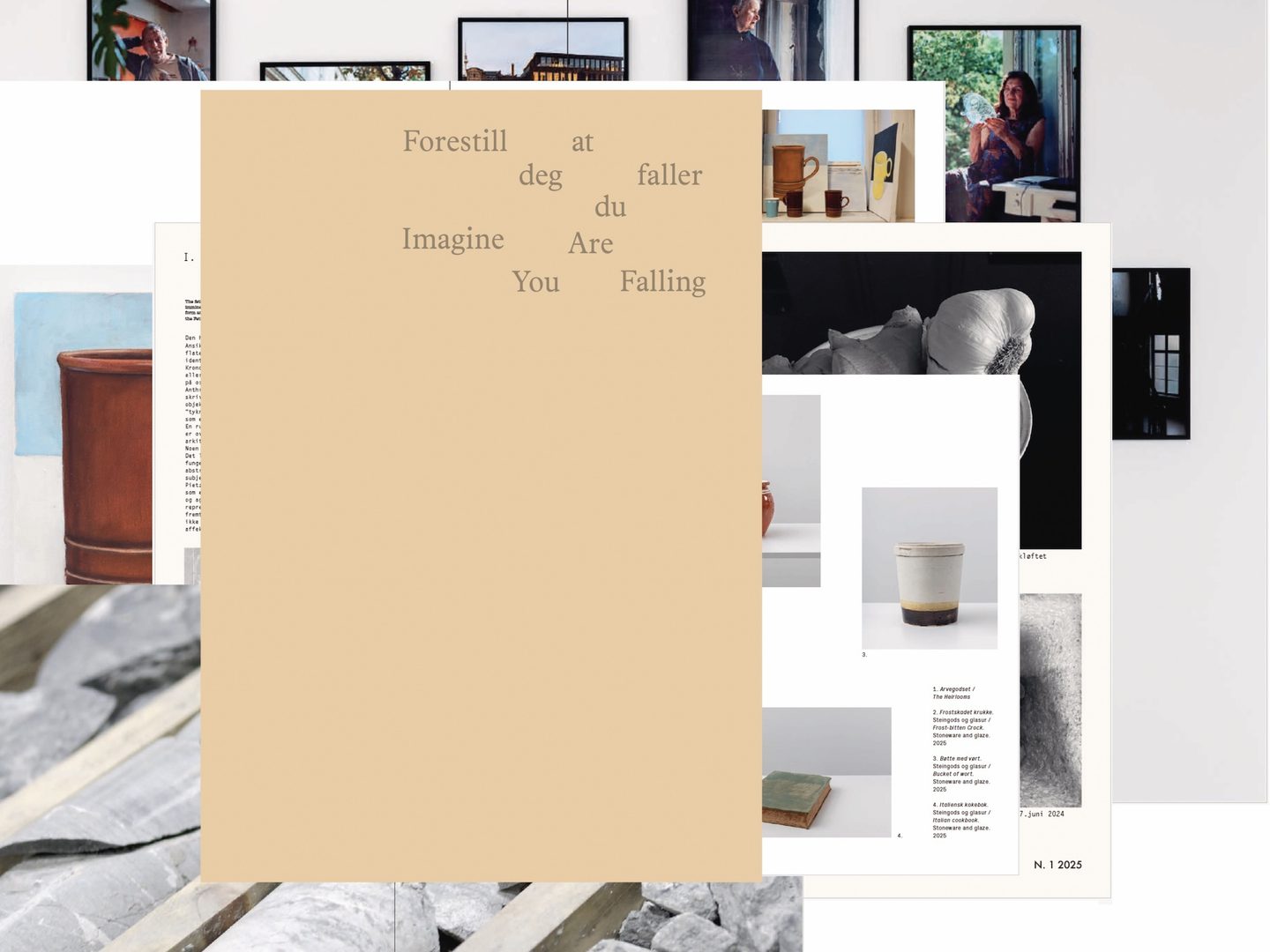
A publication will accompany the exhibition, featuring texts by writer Sigurd Tenningen and archaeologist Hein B. Bjerck. Join us for the launch Thursday 19 March from 18:00.
The exhibition is supported by the Art Centres in Norway. In addition, the artists have received support from Arts Council Norway, Norsk Fotografisk Fond, Atelier Nord, Billedkunstnernes Vederlagsfond, Bildende Kunstneres Hjelpefond, and the Norwegian Fund for Sound and Image.